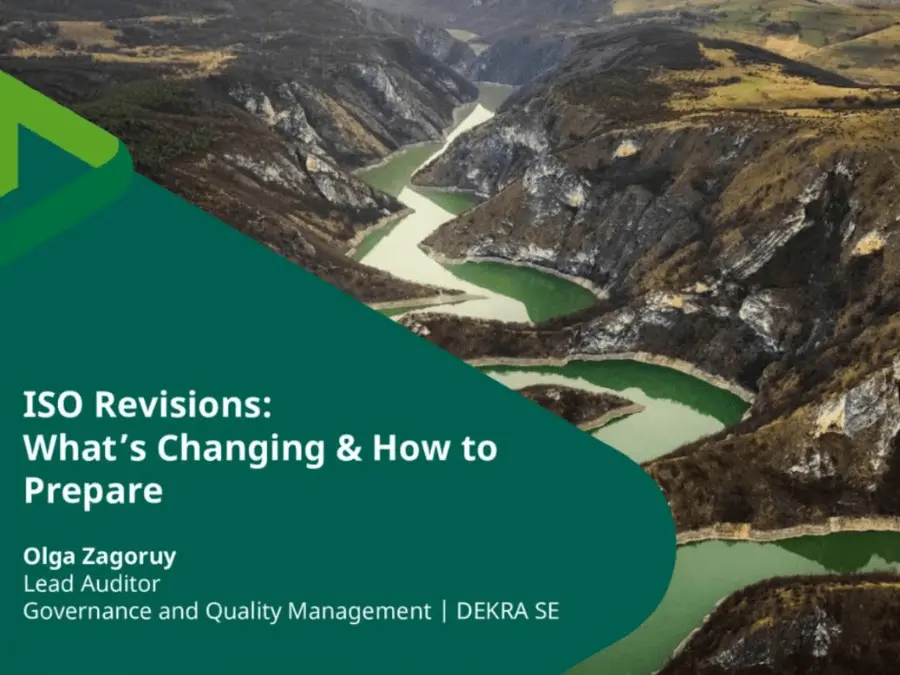
ISO 14001:2026 Revision
Key Updates, Transition Timeline and Preparation for ISO 14001:2026
The new ISO 14001:2026 edition was published 15th of April 2026 and will replace ISO 14001:2015. For organizations, early preparation is essential, as the revision introduces clearer requirements and a stronger focus on climate-related issues, life cycle thinking, change management, and environmental performance.
Our experts monitor the revision process and provide updates on key developments, transition timelines, and potential impacts on certified environmental management systems. With a structured and transparent certification approach, DEKRA helps organizations prepare for the transition with confidence.
The ISO 14001 Revision: Purpose of the Standard Update
The revision of ISO 14001 is part of the regular update cycle for international management system standards. The objective of the update is to clarify existing requirements and align them more closely with current environmental, regulatory and societal developments.
In recent years, the global environmental landscape has evolved significantly. Climate change, biodiversity loss, resource scarcity, circular economy principles and increasingly complex supply chains are shaping the expectations placed on organizations. Environmental management systems therefore need to address these developments more systematically.
The revision of ISO 14001 responds to these changes by strengthening several aspects of environmental management. In particular, the updated standard is expected to place greater emphasis on climate-related considerations, life cycle thinking, structured change management and the demonstration of measurable environmental performance.
In addition, the standard text will be aligned with the current Harmonized Structure of ISO management system standards, facilitating integration with other management system standards such as ISO 9001 and ISO 45001.
Your Path to a Successful Transition to ISO 14001:2026
The revision of ISO 14001 will affect many organizations with certified environmental management systems. Addressing the planned changes early helps organizations understand the potential impact on existing processes and prepare the transition in a structured and reliable way.
With extensive experience in auditing management systems worldwide, DEKRA conducts independent audits and certification services that enable organizations to assess their environmental management systems against the updated ISO 14001 requirements. This helps organizations gain clarity on the expected changes and prepare for the transition to ISO 14001:2026 certification.
The ISO 14001:2026 revision is expected to clarify existing requirements and strengthen key areas such as climate-related considerations, environmental performance, life cycle thinking, and structured change management. The update is considered an evolutionary development rather than a fundamental redesign of the standard.
The final version of ISO 14001:2026 was published the 15th of April 2026, following the release of the Final Draft International Standard (FDIS) in January 2026. Organizations certified to ISO 14001:2015 now have a transition period of three years to update their environmental management systems and transition their certification.
Organizations should review documented information related to context analysis, environmental aspects, risks and opportunities, and operational controls. In particular, documentation supporting climate-related considerations, lifecycle perspectives, and change management processes may require more structured and consistent evidence.
Key focus areas are expected to include climate change and environmental conditions in the context analysis, measurable environmental performance, enhanced life cycle and supply chain considerations, structured change management, and a more systematic approach to risks and opportunities.
Failure to address the revised requirements may lead to nonconformities during audits, reduced transparency of environmental performance, and gaps in risk management processes. In addition, organizations may face challenges in demonstrating compliance with stakeholder expectations related to environmental and climate-related topics.
Environmental managers, sustainability leads, and internal auditors will be particularly involved in interpreting and implementing the revised requirements. In addition, top management is expected to play a more active role in integrating environmental considerations into decision-making and ensuring the effectiveness of the environmental management system.
Organizations should ensure that relevant personnel understand the updated requirements and their implications for daily operations. This may include targeted training for environmental managers, internal auditors, and process owners, particularly in areas such as climate-related aspects, lifecycle thinking, and environmental performance evaluation.
The revised ISO 14001 will follow the ISO Harmonized Structure, which facilitates integration with other management system standards such as ISO 9001. Organizations can use this alignment to update shared processes such as risk management, internal audits, and management reviews in a coordinated manner.
Audits under ISO 14001:2026 are expected to place greater emphasis on demonstrating effective environmental performance, structured risk management, and the integration of climate and lifecycle aspects. There will also be a stronger focus on how organizations interpret and implement the revised requirements in practice and how these are evidenced during audits.
DEKRA supports organizations with independent gap analyses, and structured transition audits. This enables a transparent and reliable transition process and provides confidence in achieving ISO 14001:2026 certification.